In development · 2026 R&D program

Every point of the grid,
observable.

Advanced sensing, intelligent telemetry and grid intelligence for the next generation of power systems.

Conductor-mounted sensor concept — prototype in development
Current · PCB RogowskiVoltage · D-dotTime · GNSS
Conductor-mounted sensor concept — prototype in development
PCB Rogowski coilsD-dot sensingGNSS synchronizationEnergy harvestingNeural codecsPredictive codingLatent representationsState estimationFault locationDynamic Line RatingPower qualityOptimal sensor placementPCB Rogowski coilsD-dot sensingGNSS synchronizationEnergy harvestingNeural codecsPredictive codingLatent representationsState estimationFault locationDynamic Line RatingPower qualityOptimal sensor placement

The problem

The methods exist. The data doesn't.

State estimation, high-impedance fault location, DLR and anomaly detection already rest on solid science. What is missing is measurement — in sufficient quantity, quality and frequency.

01

The grid has changed

Distributed generation, renewables and electrification make power flows bidirectional and volatile. Operating with a handful of measurement points is no longer enough.

02

Instrumentation is expensive

Many feeders and lines still run with limited instrumentation. Every new point costs hardware, installation, power and communication.

03

Raw data doesn't scale

Streaming waveforms continuously demands bandwidth, energy and storage that field networks don't have. The bottleneck is communication, too.

“The next generation of power grids needs more than sensors. It needs a new observability infrastructure.”

Technology

A complete infrastructure, from conductor to algorithm.

Three layers designed together to reduce the total cost of observing the grid — not just the cost of a sensor.

01 Sense02 Encode03 Understand
01Advanced Grid Sensing

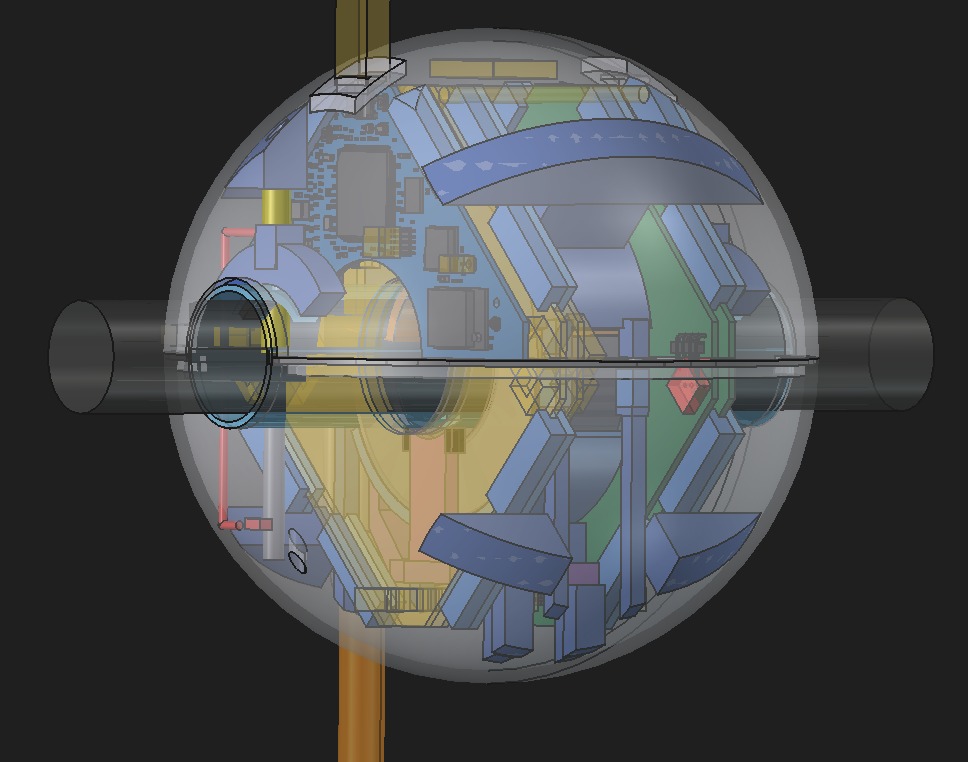
Smart conductor-mounted sensors

Compact devices installed directly on the infrastructure, targeting metrological quality at competitive cost with simplified installation.

  • Current via PCB Rogowski coils
  • Voltage via capacitive / D-dot sensing
  • High-resolution acquisition and GNSS sync
  • Embedded processing and wireless links
  • Self-powered through energy harvesting
  • Simplified installation, potentially by drone
02Intelligent Electrical Telemetry

Transmit information, not samples

Sensor and server share a model of electrical behavior. The device mainly sends what is new — the innovation its measurement adds.

Telemetry
03Grid Intelligence Platform

From distributed measurement to decision

A scalable environment ingesting conventional telemetry and high-resolution oscillography — from our sensors and, in the future, third-party devices.

  • Device management and geo-electrical views
  • Waveforms, events and history
  • Power quality, alarms and diagnostics
  • Advanced algorithms and integrations

Research front · Latent Electrical Telemetry

What if the sensor only sent what the server doesn't know yet?

A three-phase waveform is highly predictable most of the time. We investigate neural encoders and shared dynamic models so the sensor transmits compact representations and residuals — and the server reconstructs the signal or directly extracts the information an application needs.

Neural codecsAutoencodersPredictive codingShared dynamic modelsObservability-aware communication

In steady state almost nothing is sent. When an event occurs, the residual grows and detail is preserved.

Measured signalServer-side reconstruction

Illustrative visualization of the concept. Compression rates and performance depend on ongoing experimental validation.

Applications

What becomes possible when the grid is observable.

Our technology roadmap. Each application depends on measurements that are scarce today — exactly the bottleneck we target.

01

State estimation

Estimate voltages and flows with distributed, synchronized measurements, reducing reliance on pseudo-measurements.

02

Fault location

Locate conventional and high-impedance faults from traveling waves, phasors and event signatures.

03

Power quality

Monitor sags, harmonics, unbalance and transients along the feeder, not only at the substation.

04

Dynamic Line Rating

Estimate real transmission capacity from current, conductor temperature and ambient conditions.

05

Asset monitoring

Track operating conditions of equipment and infrastructure for condition-based maintenance.

06

Anomaly detection

Identify events and atypical behavior by combining signal processing and machine learning.

07

Optimal sensor placement

Decide how many sensors, where and at what quality to reach an observability target at minimum cost.

Technology direction

Each application depends on measurements that are scarce today — exactly the bottleneck we target.

Observability as a project

From an operational question to an instrumentation plan.

A utility wants better fault location on a critical feeder. Rather than selling boxes, we aim to answer — with simulation and data — what it takes to get there.

  1. 1

    Where to measure?

    Which points to instrument to make the problem observable.

  2. 2

    At what quality?

    Required accuracy class, sampling rate and synchronization.

  3. 3

    How much communication?

    Bandwidth and energy per point, with and without intelligent encoding.

  4. 4

    What performance?

    Expected estimation or location error for the chosen configuration.

  5. 5

    What total cost?

    Deployment and operating cost against operational benefit.

Research & Development

Electrical Observability Lab

A computational environment to validate architectures before building them — and to demonstrate their benefits quantitatively. Electromagnetic simulation, digital sensor models, communication and algorithms in a single chain.

  1. 01

    Grid simulation

    ATP/EMTP · Python

  2. 02

    Sensor model

    Noise · error · timing

  3. 03

    Encoding

    Compression · latent models

  4. 04

    Communication

    Loss · latency · bandwidth

  5. 05

    Reconstruction

    Waveforms · events

  6. 06

    Algorithms

    Estimation · faults · PQ

  7. 07

    Assessment

    Techno-economic

Planned evolution towards hardware-in-the-loop (HIL) testing.

Questions driving our research

  • Q1

    How do sensor quantity and quality affect electrical observability?

  • Q2

    What is the lowest communication rate that preserves a given information quality?

  • Q3

    How can latent models exploit temporal and spatial correlations between measurements?

  • Q4

    How do we preserve rare events under compression?

  • Q5

    How do synchronization and communication losses affect grid algorithms?

  • Q6

    Which sensor configuration minimizes cost for a target performance?

  • Q7

    How do we integrate sensing, communication and intelligence in one architecture?

We develop proprietary technology and intend to publish scientific results when appropriate, respecting intellectual property.

About

Power systems engineering with deep-tech ambition.

We are a Brazilian technology company born at the intersection of power systems, electronic instrumentation, data communication, artificial intelligence and optimization. We don't replace protection relays from established manufacturers — we expand the quantity and quality of information available about the grid.

Mission

Transform power system observability by democratizing access to high-quality measurements through innovative, accessible and intelligent technologies.

Vision

Make it possible to observe, understand and optimize every relevant point of transmission and distribution networks.

Engineering rigor

Claims backed by physics, simulation and testing.

Hardware + software

We design the whole chain, conductor to algorithm.

Open science where possible

We publish and collaborate with academia.

Total cost, not unit price

We optimize the system, not the part.

Partnerships

Let's build this infrastructure together.

We are looking for partners for R&D projects, field pilots and co-development.

Talk to us

Tell us about your grid's challenge. We'll reply with a technical conversation, not a pitch.

Send an email

contato@g2wia.com.br

  • Utilities

    Pilots on critical feeders and lines, regulated R&D projects.

  • Transmission operators

    Line monitoring, DLR and fault location.

  • Research centers

    Joint supervision, test benches, data and co-authored publications.

  • Manufacturers & integrators

    Integrating sensors and platform into existing portfolios.

  • Investors

    A deep-tech thesis in critical infrastructure.